
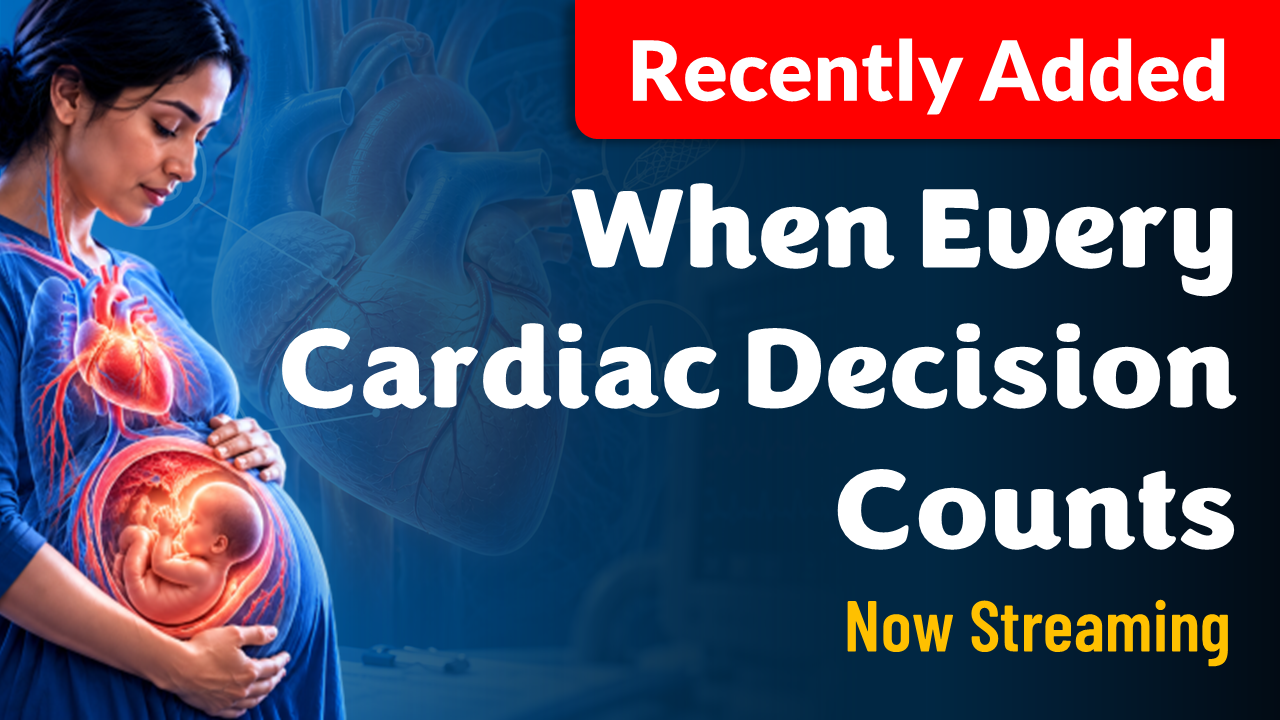
Day 3 after a caesarean, she is breathless, her EF is under 40%, and the diagnosis is still open. Dr Rekha Rajendrakumar takes six PPCM nightmares from the labour room to the transplant list.
One patient, three possible diseases (Watch segment 45:39 - 47:44)
A 30-year-old G4P3 with IVF twins had an emergency caesarean at 35 weeks for severe preeclampsia. Just before discharge, she became breathless. Echo showed LVEF below 40%, moderate mitral regurgitation and a markedly raised BNP. Is it PPCM, hypertensive heart failure, or unrecognised dilated cardiomyopathy? Pure PPCM recovers by about five months, while pre-existing disease stays for life. Hence, “you have to put her in one of the three boxes.”
Deliver or stabilize? (Watch segment 47:44 - 50:37)
A 32-year-old at 37 weeks, more than 4 cm dilated, had SpO2 below 90%, hypotension, tachycardia, EF 18% and recurrent fetal decelerations. Cardiology works to lift EF towards 35–40% while the obstetric clock runs. If it stays at 18%, she needs an emergency caesarean with invasive monitoring and critical care support, because a 4–6 hour labour is a strain her heart cannot take.
Shock without the option of fluids (Watch segment 50:37 - 52:44)
A 29-year-old with known PPCM (EF 25%) had a caesarean complicated by atonic PPH of nearly 2 litres. She was hypovolemic, yet fluid pushes a failing heart further, so the call is fluid versus vasopressor, made with the cardiologist. Ergometrine is contraindicated at low EF, as it sends myometrial blood back as a preload gush. Early surgical intervention, massive transfusion and ICU care follow
The thrombus that can move (Watch segment 52:44 - 54:35)
At four weeks postpartum, a 35-year-old had only mild exertional dyspnoea, yet EF was 20% with a mobile LV apical thrombus and pulmonary emboli on CT. Anticoagulation clears the thrombus but raises bleeding concerns, a choice “between the devil and the deep sea.” Who to screen, who to anticoagulate and for how long all need deciding.
Recovered, but not safe (Watch segment 54:35 - 57:01)
Her EF rose from 22% to 58%, but global longitudinal strain stays abnormal and stress echo shows reduced contractile reserve. “Right now, on this day, on this moment, she is fine,” yet pregnancy, delivery or PPH could return her to 22%. She needs a cardiologist before conception, and documented contraception and pregnancy advice.
When optimal therapy isn’t enough (Watch segment 57:01 - 59:28)
A 34-year-old, two weeks postpartum, had EF 10%, RV dysfunction, ventricular arrhythmias, renal impairment and inotrope dependence despite perfect medication. “Enough is enough.” Refer early to advanced heart failure centres for ECMO, LVAD or transplant evaluation.
Across all six, the lesson is the same: label the disease early, treat heart and pregnancy side by side, and escalate before waiting becomes the complication.